
Dog skin disease recovery period: the order of using sterile dog diapers and topical medications

Dog skin problems are a real headache for many pet owners.
From common eczema, fungal infections, and bacterial dermatitis to more challenging parasitic skin diseases, nearly every condition can cause dogs to experience redness, itching, oozing, and even bleeding from scratching. Of all the stages, the recovery period is the most easily overlooked, yet also the most critical.
Why do I say this? Because if improper care is taken during this stage—for example, if medications are used in the wrong order, the skin remains moist, or the dog constantly licks and scratches—the skin inflammation may recur and even leave permanent scars.
At this time, the combination of sterile dog diapers and topical medications often determines the speed of recovery and effectiveness.
1. Nursing principles during the recovery period of skin diseases
During the recovery phase, our goals can be summarized in six words: protect, control, and repair.
It sounds simple, but every step is about details.
- Reduce mechanical stimulation: The most basic thing is to prevent the dog from scratching or licking. Even if it is just a slight friction, the damaged skin may break again.
- Keep it dry and clean: A humid environment is a paradise for bacteria and fungi. Remember to ventilate the area after drying it, and don’t rush to wrap it.
- Follow the doctor’s instructions for treatment: Some fungal or parasitic infections require a combination of oral and topical medications to be completely cured.
- Strengthen the skin barrier: During the recovery period, you can use repair agents or nutritional supplements to help the skin regenerate.
- Find out the cause of the disease: allergies, parasites, endocrine problems… If the root cause is not resolved, the disease may recur even if the surface heals.
- Be patient: Many dog skin diseases take weeks to fully recover and cannot be cured by applying ointments in a few days.
Simply put, the recovery period is not a process of “curing” but a process of “stabilizing.”
2. The role and precautions of sterile dog diapers during the recovery period
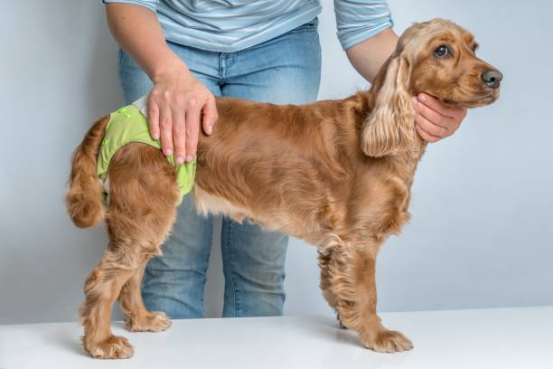
Many people think “dog diapers” are just for urine protection. In fact, sterile diapers can play a crucial role in protecting
skin during the recovery period. This is especially true for open lesions like the abdomen, tail base, and inner hind legs. Dog diapers can protect those areas from friction and bites.
1. Usage scenarios and main functions
- Prevent licking and scratching: A dog’s tongue may seem gentle, but it’s actually very rough. Frequent licking can worsen the infection. Diapers can isolate the wound, allowing the medication to work better.
- Keep the area clean: When there is secretion, dog diapers can absorb the liquid and reduce the contact between the skin and dirt.
- Block cross-infection: Prevent skin exudate from contaminating the environment and prevent other pets or people in the home from being exposed to bacteria.
Of course, dog diapers are only auxiliary tools and cannot replace drug treatment. If the care is not in place, it may even become a new source of infection.
2. Criteria for selecting sterile dog diapers
When choosing diapers, you should not only consider the size but also the recovery period.
It is recommended to choose diapers with the following characteristics:
- Sterile or antibacterial layer: prevents bacteria from growing on the diaper itself;
- Breathable and absorbs moisture quickly: Skin must remain dry, especially in humid climates;
- wound, andFits snugly but not too tight: too tight will rub the wound, too loose will not provide protection.
- Soft material, low stimulation: avoid secondary friction;
- Removable or window design: convenient for checking wounds and taking medicine.
Diapers should fit “snugly but not too tight” and ensure the skin remains ventilated and dry.
3. Usage Tips and Tricks
- Frequent changes are key: the skin is more fragile during the recovery period, so diapers should be changed more frequently than usual.
- Regular ventilation: remove it every few hours to allow the skin to ventilate naturally;
- Cleaning process: After removing the diaper, wash it with warm water or saline, then dry it thoroughly, and finally apply the medicine.
- marks,Observe the reaction: If you see red spots, friction marks or increased exudation, stop using the product immediately and check for the cause.
- Avoid wound edges: Do not let the diaper press on open skin lesions; otherwise, it will easily trap moisture and hinder healing.
To sum up in one sentence: Dog diapers can protect the skin, but they must not make the skin “stuffy.”
3. The order and key points of using external medications
beThe correct order of using topical medications is a key point that many owners tend to overlook.
In simple terms, a complete process should be:
1. Clean → Dry → Apply → Absorb → Cover
Step 1: Cleaning
Use a mild, veterinarian-recommended cleanser or saline solution to clean the surface of the wound.
Step 2: Dry completely
with a soft towel. Do not rub. A moist environment will weaken the efficacy of the medicine.
Step 3: Apply
antibacterial, antifungal, or repair ointment as directed by your doctor. Apply a thin layer.
Step 4: Allow the medicine
To sit for a few minutes after application, do not cover it immediately.
Step 5: Cover with a protective layer.
Add sterile gauze or thin dog diapers as needed to prevent the dog from licking the medicine off.
Different types of skin diseases require different types of medications, such as:
| type | reason | Topical strategies |
| bacterial dermatitis | Scratches, pus-filled skin | Antibacterial spray/silver ion ointment |
| fungal infection | Wet or over-cleaned | Antifungals (ketoconazole, miconazole) |
| Allergic dermatitis | Contact allergens | Combined use of hormones and repair agents |
| Parasitic dermatitis | insect bites | Insect repellent and anti-inflammatory ointment |
| Autoimmune skin diseases | Immune abnormalities | Topical immunomodulators (e.g., tacrolimus) |
All medications must be used on clean, dry skin. Applying wet medications, applying thick ointments, or covering the skin with dog diapers before it is absorbed will affect the effectiveness of the medication.
4. Coordination skills of sterile dog diapers and topical medications
How can we achieve “drug efficacy without compromising skin protection”?
The key lies in mastering the time difference and air flow.
- Apply medicine first, then cover: Allow time for the medicine to be absorbed before putting on dog diapers.
- Choose a windowed or detachable design: convenient for observation and medication application at any time.
- Allow your skin to breathe: Don’t leave it on all day. Take it off for a few hours to let your skin breathe, and the effect will be better.
- Alternating protection method: Cover with gauze when the skin is in good condition, and use diapers when it is serious.
- Observe your skin regularly: redness, swelling, oozing, and odor are warning signs; stop use immediately and seek medical attention.
This cycle of “medicine-absorption-covering-breathing” is the truly effective care rhythm.
5. What signals indicate that you should be alert?
Even if you appear to be recovering well, pay attention to these details:
- Sudden redness, hair loss, and oozing of the skin;
- The dog scratches frequently and shows pain reactions.
- The discharge becomes cloudy and has a foul odor.
- Loss of appetite and mental fatigue;
- New lesions spread to other areas.
These are all possible signs of “secondary infection.” Be sure to stop using diapers and seek timely follow-up treatment.
Conclusion: Careful care is the best medicine
The recovery process of a dog’s skin disease is like a tug-of-war.
You need enough patience, the right order, and the right tools.
Sterile dog diapers can help you control the environment, protect the skin, and reduce infection.
while topical medications are the core of true healing. The proper combination of the two can make recovery more stable and faster.