
Dog marking behavior correction: A guide to transitioning tools for Dog diapers

When your “well-behaved dog” suddenly starts leaving tiny “marks” on furniture, doorknobs, and even guests’ bags, you might feel confused and frustrated. Actually, this behavior is called marking in the canine world, and it’s one of their normal ways of communication. However, if marking occurs frequently in the indoor environment, it can become a training and management problem. This article will analyze the reasons for canine marking behavior and common scenarios and focus on how to use dog diapers as a transitional tool. Through positive guidance, training, and environmental management, it’s possible to effectively reduce destructive behavior and ultimately correct the marking habit.
I. What is dog marking behavior?
Marking behavior differs from ordinary indoor elimination. It is not an accident of “not being able to hold urine,” but rather a way for dogs to leave a scent on a vertical or conspicuous object with a small amount of urine (or occasionally feces) to convey a message.
(1) Common triggering reasons
- Territory and communication: Dogs release pheromones through urine to tell other dogs, “I’m here.”
- Environmental or family changes: Moving, new furniture, new pets, and changes in family members can all trigger marking behavior.
- Sex hormone effects / Unneutered status: Unneutered male dogs exhibit marking behavior more frequently, but even after neutering, existing habits may continue.
- Anxiety, stress, or competition: In multi-dog households or due to external stimuli (barking dogs outside the window, visitors), dogs may use marking to relieve anxiety.
(2) Distinguishing it from “indoor excretion errors”
Urine output during marking behavior is usually small and occurs near vertical objects, while urine output during normal urination errors is large and occurs at random locations. The essence of marking is “leaving a mark,” not “not having a chance to go out.”
II. Why choose dog diapers as a transitional tool?
You might ask: If training and environmental management are key, why use dog diapers? The answer is that they are tools to assist management and reduce frustration, not the final solution.
- To reduce destruction and frustration
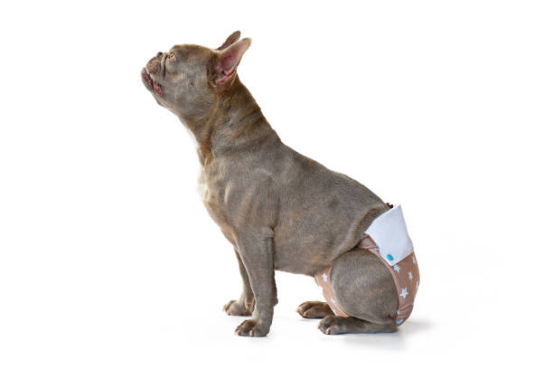
Dogs may still mark furniture or carpets in the early stages of training. Using dog diapers (or a belly band for males) can temporarily prevent destruction, giving you time to work on training, environmental management, and behavioral substitutions.
- Providing dogs with a sense of security:
Dogs may experience anxiety or decreased self-confidence if they are scolded for being marked. Dog diapers allow dogs to safely release their marking urges during the transition period, avoiding negative self-evaluation and making them more receptive to positive training. - in conjunction with training
is not the end goal, but rather an aid to training. Wearing diapers reinforces supervision, guidance, and rewarding correct behaviors, with the ultimate goal of reducing diaper dependence. The belly band is merely for environmental protection and will not teach the dog to abandon marking behavior.
III. Four-Step Practical Procedure for Training Dog Diapers
The following is a practical and feasible process: Identify the problem → Environment management → Positive training → Gradually remove the diaper.
Step 1: Identification and Preparation
- Take your dog to the vet to rule out urinary tract infections or bladder problems.
- Record marking patterns: when, where, and under what stimulus.
- Purchase dog diapers or belly bands of the appropriate size to ensure they are breathable, comfortable, and not too tight.
Step Two: Environmental Management and Supporting Protection
- Block off high-risk areas: use baby gates, fences, or closed curtains.
- Clean the marked areas thoroughly and use an enzyme cleaner to completely remove any remaining odor.
- Put dog diapers on your dog when unsupervised to prevent damage, and change them regularly to avoid skin problems.
Step 3: Positive Behavior Training
- When signs appear in high-risk areas, promptly shift your attention (e.g., “toys” or “instructions”).
- Immediately praise and reward your dog with a small treat when it relieves itself or relaxes in the designated spot to reinforce the correct behavior.
- Reduce reprimands and punishments while using dog diapers, as these may exacerbate anxiety.
Step 4: Gradually remove dog diapers
- If the frequency of tagging decreases while the dog is wearing diapers, try removing the dog diapers from the restricted area.
- Gradually increase the range of freedom while reducing diaper usage.
- If the dog behaves consistently, the dispensing can be completely removed; if the problem recurs, continue wearing the dispensing and review the training.
IV. Common Scenarios and Recommendations for Using Dog Diapers
a new home or a new pet being added to
the tagging process increases, so wearing dog diapers can act as a “buffer,” while also providing patrols and positive reinforcement.
For male dogs that are not spayed or are significantly affected by hormones,
A belly band and dog diapers can help manage marking impulses and make the training transition smoother.
For families with many members or frequent visitors
Dog diapers are most effective in preventing furniture damage when used in conjunction with supervision, training, and cleaning.
V. Common Misconceptions and Precautions
Myth: dog diapers are the solution.
Dog diapers are just an auxiliary tool and cannot replace training and environmental management.
Myth: Punishment is faster than reward.
Punishment may cause anxiety or avoidance and does not truly solve the marking problem.
Note: Wearing time and skin health.
Dogs have sensitive skin, and wearing dog diapers for a long time may cause dampness and skin problems. They need to be changed regularly, and dogs should be allowed to be naked occasionally.
Note:
Ignoring underlying reasons such as anxiety, pet conflict, or environmental changes, dog diapers alone cannot fundamentally improve the situation.
VI. Conclusion: Making dog diapers an aid to behavior change
Marking behavior is part of a dog’s natural instinct, but when it affects home comfort or furniture, positive intervention is needed. Using dog diapers as a supplementary protection and transition tool, combined with environmental management, behavioral training, and cause analysis, can help dogs gradually establish correct elimination habits.
Remember the four core steps:
- Confirm the cause
- Environmental management and dog diapers assistance
- Positive behavior training reinforcement
- Gradually remove the diaper.
Every step is designed to instill in your dog the message, “I am in the right place, and I know what I am supposed to do.” May you and your dog experience less frustration and more success during training. Let’s keep going!